
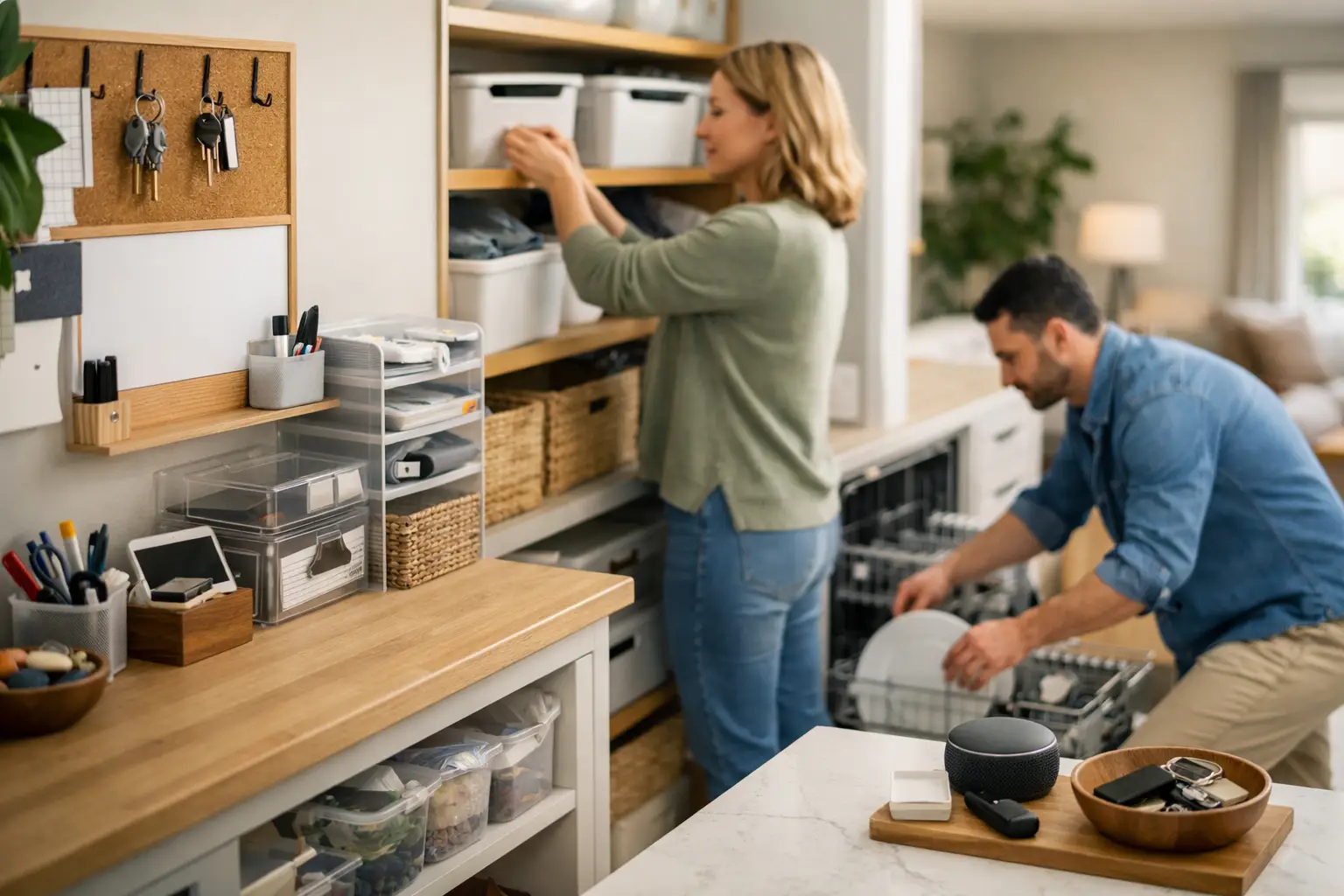
A full laundry basket by the door, unopened mail on the bench and a missing school hat can look like small things. Together, they can make a weekday morning feel impossible. ADHD friendly home systems are not about creating a picture-perfect house. They are about reducing the number of decisions, searches and last-minute rescues required to get through everyday life.
For many people with ADHD, a system only works if it is visible, simple and forgiving on the hard days. A complicated organising method may look impressive at first, but if it requires ten steps to maintain, it can quickly become another source of pressure. The goal is a home that supports how your brain and household actually function.
What makes a home system ADHD friendly?
An ADHD-friendly system works with real behaviour rather than relying on ideal behaviour. It makes the next action obvious, keeps essential items easy to see and reduces the effort needed to reset a space.
This matters because home tasks rarely arrive one at a time. Dinner needs making while someone is looking for a charger, the dog needs feeding, a work message arrives and tomorrow’s permission slip is still unsigned. When every task depends on remembering where something goes or what happens next, overwhelm can build quickly.
A helpful system usually has three qualities. It has a clear home for important items, it is located where the item is naturally used, and it is easy to restore after a busy day. If the system needs you to remember an extra rule, open multiple cupboards or wait until you have a block of free time, it may need simplifying.
Start with friction, not a full-house overhaul
The most effective changes often begin with one repeated point of stress. Perhaps keys disappear every morning. Perhaps clean clothes remain in a basket because putting them away feels too big. Perhaps paperwork lands on every available surface.
Choose one problem that affects your day often, then ask: what is making this harder than it needs to be? The answer is rarely a lack of effort. More often, the item has no obvious home, the storage is inconvenient, or the task contains too many hidden steps.
For example, a key hook near the front door may work better than a decorative tray in another room. A laundry basket for each person may be more useful than a carefully sorted washing routine. A large, labelled inbox for all incoming paper can be a practical first step before deciding what to do with it.
Small changes create useful evidence. When one system makes mornings calmer or reduces an argument about lost belongings, you learn what kind of support your household responds to.
ADHD friendly home systems for the everyday pressure points
Create landing zones where life actually happens
A landing zone is a designated place for the things that arrive and leave with people every day. Put it close to the natural entry point, not where it would look best in a magazine.
A simple entryway setup might include hooks for bags, a spot for shoes, a basket for library books or returns, and a visible place for keys. Families may also benefit from a single area for school notices, sports gear and items that need to leave the house tomorrow.
The key is to avoid making the zone too detailed. If every item needs its own tiny compartment, it may be difficult to maintain. Broad categories are often enough: out-the-door items, returns and things needing attention.
Make supplies visible and easy to reach
Out of sight can quickly become out of mind. This does not mean every surface needs to be crowded. It means the items you use frequently should not be hidden behind other items, stored too high or split across several rooms.
Clear tubs, open baskets, labels and shelf risers can help, especially for cleaning supplies, pantry staples, chargers and craft materials. For some people, open storage is more useful than closed cupboards because it removes the need to search.
There is a trade-off here. Open storage can look visually busy, which may feel distracting in a small space. If that is the case, use opaque bins with large labels or keep only daily essentials visible. The best option is the one that you can find and put away without extra effort.
Reduce the number of steps in routine tasks
Many home tasks are not difficult because of the task itself. They are difficult because they involve several transitions. Washing clothes can mean collecting them, sorting them, finding detergent, starting the machine, moving the load, folding it and putting it away. That is a lot to hold in mind.
Look for ways to shorten the chain. Keep detergent beside the machine. Use fewer laundry categories. Place a donation bag in the wardrobe rather than planning a separate decluttering session. If folding is the sticking point, consider whether each person can use labelled baskets or drawers for everyday clothes instead.
A system does not have to be conventional to be useful. It needs to reduce friction while still meeting your household’s needs.
Build visual routines for shared spaces
Shared spaces can create tension when expectations are invisible. A short visual routine can make the next step clearer for children, teens, partners and housemates without turning the home into a rulebook.
In the kitchen, a small checklist might show what happens after dinner: plates to the dishwasher, leftovers into containers, bench wiped, bag packed for tomorrow. In the bathroom, it may be as simple as a basket for used clothes and a hook for towels.
Keep these prompts brief and specific. A sign that says “clean your room” is broad and easy to avoid. A prompt such as “dirty clothes in basket, cups to kitchen, school bag by door” gives a clear starting point.
Use a weekly reset, not constant catch-up
A home does not need to be reset perfectly every day. In fact, expecting that can make it harder to begin after an already demanding week. A short weekly reset creates a predictable time to restore the systems that support the next few days.
Choose a realistic window, such as Sunday afternoon or a quieter weeknight. Focus on the areas with the biggest impact: washing, food basics, rubbish, school or work items, and the entryway. Set a timer if a defined finish point helps you start.
It may help to separate resetting from deep cleaning. A reset is about making daily life workable. It is not a test of whether your home meets someone else’s standards.
Involve the household without carrying the whole system
When one person becomes the unofficial manager of every bag, meal, appointment and missing item, the system is not really supporting the household. It is relying on one person to remember everything.
Where possible, involve the people who use the system. Ask what gets lost, what causes delays and what would make the task easier to complete. Teenagers may be more likely to use a charging station they helped choose. Young children can participate through simple pictures, low hooks and easy-to-reach baskets.
This approach is especially valuable for adults who have spent years being told they are disorganised or inconsistent. Systems are not a measure of character. They are practical supports, and they can be adjusted when they stop fitting.
Give new systems a fair trial
Try one change for two weeks before deciding whether it works. Notice when it is used, when it is ignored and what gets in the way. If the key hook is still empty, it may be in the wrong place. If the paper inbox overflows, perhaps it needs a five-minute weekly check rather than a more elaborate filing method.
Avoid treating a missed day as proof that the system has failed. Every household has busy periods, low-energy days and unexpected changes. A helpful system makes it easier to return after those moments.
ADHD coaching can offer structured support for identifying the friction points that matter most and building routines that suit your home, responsibilities and strengths. The aim is not stricter rules. It is practical progress that feels possible to maintain.
Choose one small area that regularly steals time or energy this week. Make the next action easier to see, easier to start and easier to repeat. A calmer home often begins with a hook, a basket or one less decision at the end of a long day.