
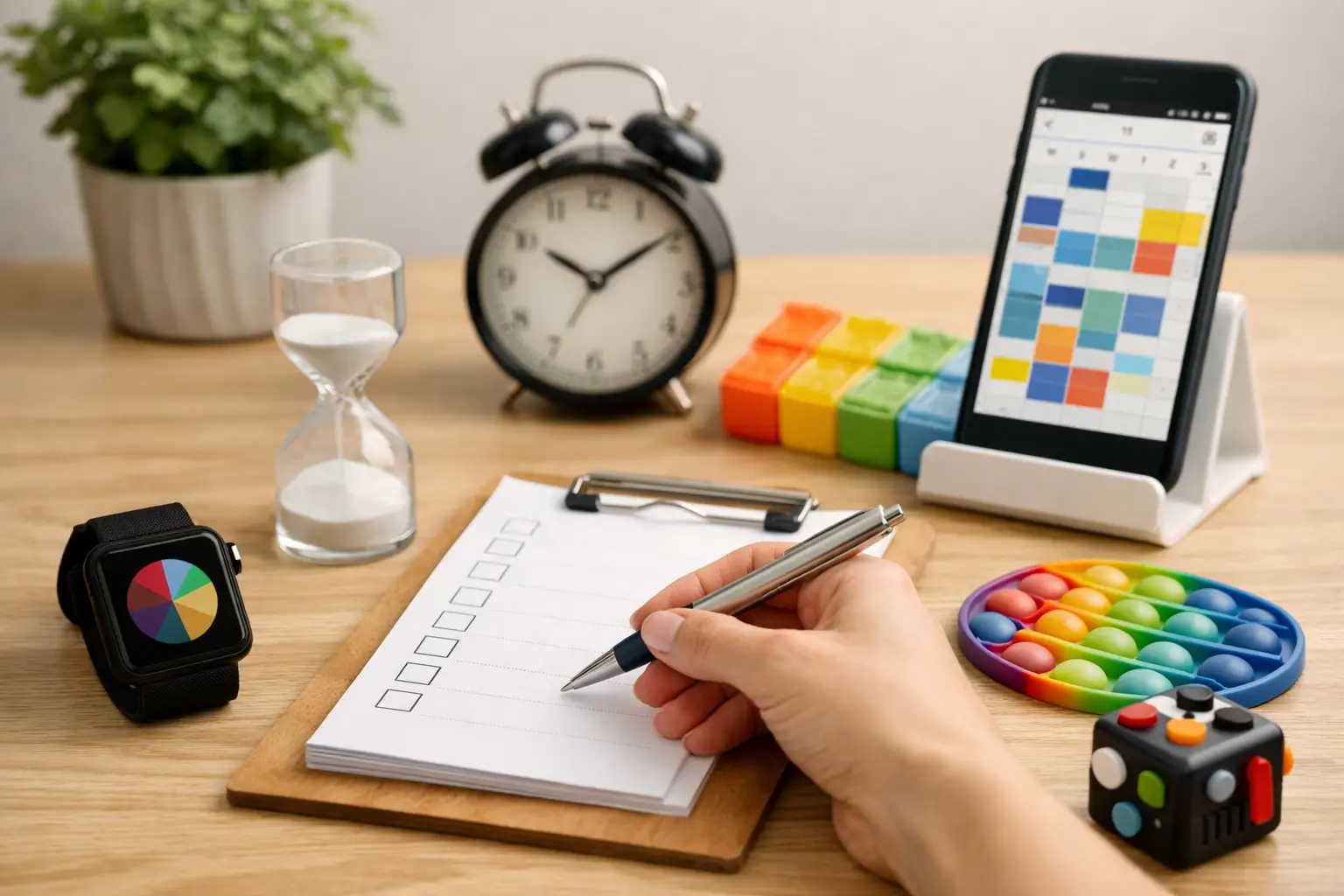
If you have ever bought a planner with the best intentions, used it for three days, then forgotten it existed, you are not the problem. Finding the best ADHD tools for routines is rarely about picking the fanciest app or the most colour-coded system. It is about choosing supports that reduce friction, make time visible, and work with your real life rather than an ideal version of it.
That matters because routines can feel especially slippery with ADHD. You might know exactly what needs doing, yet still struggle to start, switch tasks, remember steps, or follow through when the day goes off track. The right tool will not do the routine for you, but it can make the next action clearer and easier.
What makes a routine tool actually helpful for ADHD?
The most useful ADHD routine tools tend to do one of four things. They make time easier to see, reduce the number of decisions you need to make, create an external prompt, or add enough structure that you do not have to hold the whole plan in your head.
That is why a tool that works beautifully for one person may be useless for another. A detailed digital planner might help someone who enjoys setting up systems, while another person needs a whiteboard on the fridge because anything hidden inside a mobile app disappears from awareness. The best tool is the one you will reliably notice and use when you are tired, distracted, running late, or already overwhelmed.
The best ADHD tools for routines at home, school and work
1. Visual timers
A visual timer is often one of the most effective tools for ADHD because it turns abstract time into something concrete. Instead of thinking, I should get ready soon, you can see that 15 minutes is passing. This is especially helpful for mornings, transitions, homework blocks and tasks that tend to stretch out longer than expected.
The trade-off is that timers can become part of the background if you use too many. Keep them for moments where time blindness causes the biggest problems. One timer used consistently is usually better than five that all compete for attention.
2. Whiteboards and visual planners
For many people with ADHD, out of sight really does become out of mind. A wall planner, fridge whiteboard or desk-based visual schedule keeps the routine visible without requiring you to open an app, remember a password, or click through three tabs.
This works well for family routines, teen study schedules, and adults juggling work and home tasks. The key is not making it too detailed. If the board becomes cluttered, it stops feeling useful and starts feeling noisy.
3. Recurring alarms with labels
An alarm that says alarm is easy to ignore. An alarm labelled start lunch prep, leave for school pickup, or 10-minute reset gives your brain a direct instruction. That small shift matters more than people think.
Labelled alarms are particularly useful for transition points, which are often where routines fall apart. The caution here is alarm fatigue. If your mobile is buzzing every 20 minutes, you may stop responding altogether. Choose a few high-impact prompts instead of trying to automate your entire day.
4. Checklists for repeatable routines
A checklist removes the mental load of remembering each step. That can help with morning routines, bedtime routines, packing a school bag, shutting down work for the day, or getting out the door. It is not about treating adults like children. It is about reducing the demand on working memory.
The best checklists are short, specific and placed where the routine happens. A bathroom mirror checklist for mornings will usually beat a beautiful notebook left in the kitchen drawer.
5. Body doubling
Not every ADHD routine tool is an object or app. Body doubling means doing a task while another person is present, either in person or virtually. For many people, this creates enough accountability and focus to start and continue a task that otherwise feels hard to begin.
This can be useful for study sessions, admin blocks, tidying, meal prep or end-of-day planning. It will not suit everyone. Some people find another person distracting. But for many, it turns intention into action far more effectively than trying to push through alone.
6. Habit stacking cues
Habit stacking is less about adding another tool and more about attaching a task to something you already do. For example, taking the bins out after brushing your teeth at night, checking tomorrow’s calendar while having breakfast, or plugging in your laptop as soon as you get home.
For ADHD, this works best when the cue is obvious and physical. Pairing one action with another can reduce the need to remember from scratch. If the stack gets too long, though, it becomes fragile. Start with one reliable pairing rather than building a complicated chain.
7. Launch pads and drop zones
A launch pad is simply a set place for the things you need to leave the house or start your day – keys, bag, headphones, charger, lunch, water bottle. It sounds basic, but it can remove a surprising amount of last-minute stress.
This is one of the best examples of an ADHD-friendly tool because it reduces decision-making and searching. The routine becomes less about remembering where things are and more about returning them to one home. The trick is to make the spot easy, visible and close to the door.
8. Digital task managers – used lightly
Apps can help, especially if you need reminders across work, study and family life. A good digital task manager can store recurring tasks, prompt deadlines, and help you break larger routines into smaller actions.
But there is a catch. Many people with ADHD spend more time setting up the system than using it. If you choose a digital tool, keep it simple. One inbox, a few recurring routines, and clear reminders are enough. You do not need a perfect productivity dashboard.
9. Preparation baskets or routine kits
If a task has lots of parts, a routine kit can remove the start-up barrier. That might be a study basket with chargers, pens and notes, a shower caddy with what you need for the morning, or a meal prep tub in the fridge. The idea is to reduce the number of mini-steps between intention and action.
This can be particularly helpful for teens, busy parents, and women carrying a high mental load at home and work. Less searching often means less resistance.
10. Weekly reset sessions
Daily routines usually work better when they sit inside a simple weekly reset. This is a regular time to check the calendar, refill what has run out, review upcoming commitments, and reset key spaces. It can be as short as 15 to 20 minutes.
Without this step, routines often unravel because the basics have not been maintained. A weekly reset gives you a chance to notice problems before they become chaos. It is not about catching up on everything. It is about making the next few days easier.
How to choose the best ADHD tools for routines
Start by looking at where your routine actually breaks. If mornings are chaotic, a visual checklist, timer and launch pad may help more than a sophisticated planning app. If work tasks are getting lost, labelled alarms and a simple digital task manager may be the better fit.
It also helps to ask what the real barrier is. Are you forgetting? Avoiding? Losing track of time? Getting stuck on transitions? Different tools solve different problems. A timer will not help much if the issue is that your bag, laptop and charger never live in the same place.
Try to test one or two tools at a time. When people feel overwhelmed, they often respond by creating a much bigger system than they can maintain. That can feel productive for a day or two, then collapse under its own weight. A smaller system that survives a messy week is usually the stronger option.
Why routines fail even with good tools
Sometimes the issue is not the tool. It is the expectation attached to it. If your routine only works on quiet days, when you have slept well, feel motivated, and nothing unexpected happens, it is too brittle.
ADHD-friendly routines need room for variation. That might mean having a minimum version of your morning routine, a backup checklist for low-energy days, or a reset point if the afternoon gets derailed. Flexibility is not failure. It is part of making routines sustainable.
This is also where support can make a real difference. At ADHD Coaching Australia, routine-building is approached as a practical skill, not a test of willpower. The goal is to create systems that fit the person, their environment and their responsibilities, rather than forcing them into someone else’s version of organisation.
A useful routine should help you feel less overloaded, not more controlled by your own planner. If a tool adds guilt, complexity or too many steps, it may be the wrong tool for this season of life.
The best place to begin is not with a total life overhaul. It is with one sticky point in your day, one simple support, and one routine that feels easier to repeat tomorrow.
If you’re struggling to follow through despite trying different strategies, you may need a complete system designed around how your brain works.
Explore ADHD System Builds for a structured approach.