
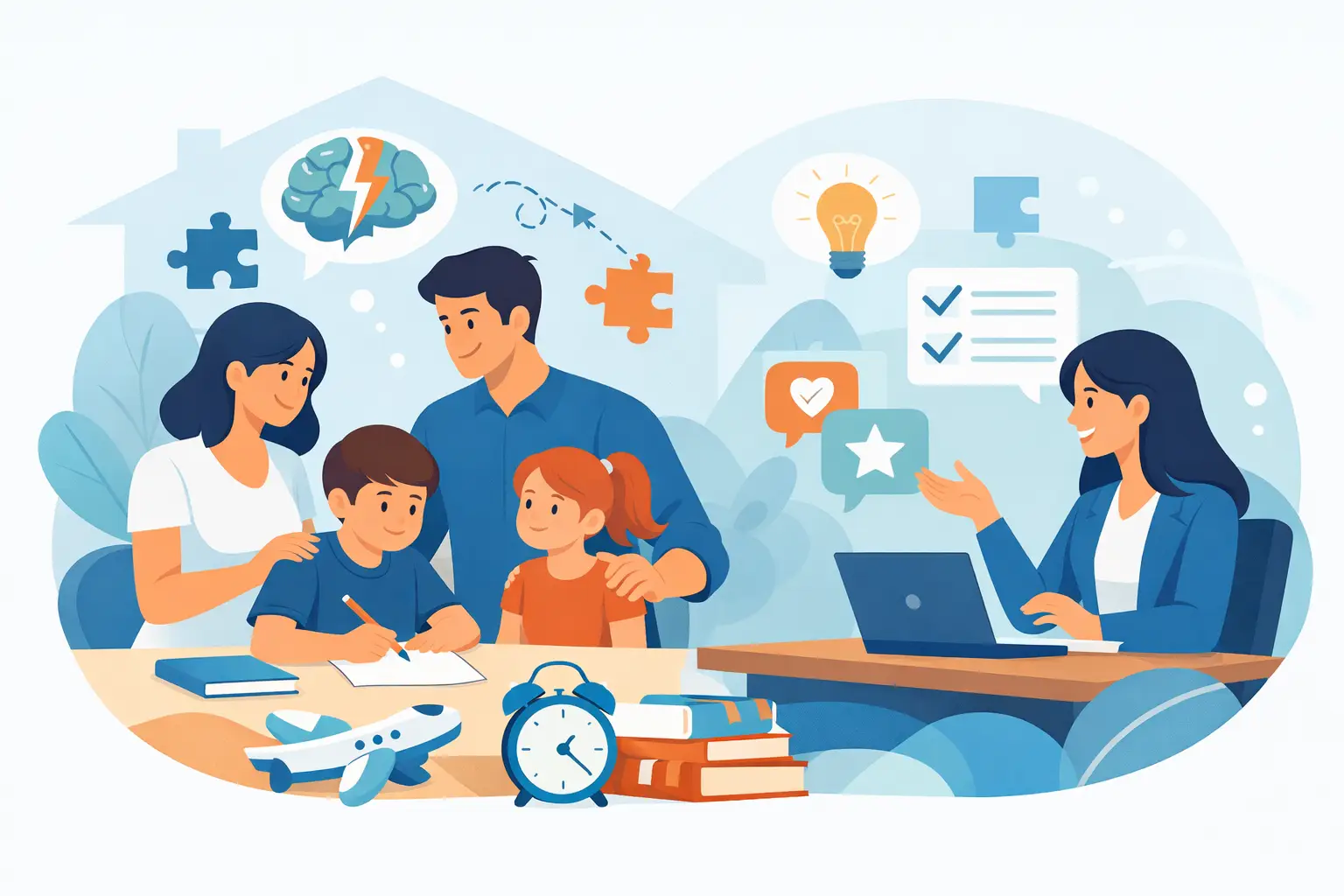
Some families spend most of the week stuck in the same loop – missed shoes, forgotten homework, rising voices, hurt feelings, then guilt afterwards. If ADHD is part of the picture, that loop can feel relentless. A good family ADHD support guide is not about making everyone more obedient or more productive. It is about helping the household work with ADHD more skilfully, with less shame and more structure.
That matters because ADHD rarely affects one person in isolation. It shapes mornings, transitions, communication, emotional regulation, sleep, school demands, work pressure, and the general tone of home life. In many families, one child has ADHD, then a parent starts recognising their own traits as well. In others, a teen is struggling, but the conflict around the struggle becomes just as exhausting as the symptoms themselves. Support needs to be practical, realistic and flexible enough for real homes, not perfect ones.
What a family ADHD support guide should actually do
The most useful support gives families two things at once – emotional safety and workable systems. Emotional safety means family members are not constantly framed as lazy, careless, dramatic or difficult. Workable systems means there is a clear way to handle the recurring stress points that ADHD tends to amplify.
Without both, progress usually stalls. If a family has compassion but no structure, everyone may feel understood but still overwhelmed. If a family has rules without understanding, the house can become tense very quickly. ADHD support works best when expectations are clear, the environment reduces friction, and communication stays respectful even when things go off track.
This is especially important for women and girls, who are often missed or misunderstood. A child who seems dreamy, sensitive or disorganised may be working very hard to mask. A mother holding the household together may look capable from the outside while privately dealing with time blindness, burnout and constant mental overload. A strong family approach makes room for these quieter presentations as well.
Start by reducing blame, not raising pressure
Many families come to ADHD support after years of trying harder. More reminders, more consequences, more frustration. It is understandable, but it often backfires. ADHD affects executive functioning, which means skills like planning, sequencing, starting tasks, shifting attention and regulating emotion do not always show up consistently, even when the person cares deeply.
That does not mean there should be no accountability. It means accountability has to match how ADHD actually works. A child may need a visual checklist instead of repeated verbal prompts. A teen may need help breaking a task into the first three steps, not another lecture about potential. A parent may need to stop relying on memory and start using shared routines and external cues.
A simple shift in language can help. Instead of asking, “Why do you keep doing this?” ask, “What made this hard today?” Instead of saying, “You never listen,” try, “Let’s work out a way to make this easier to remember.” These changes are not about avoiding difficult conversations. They lower defensiveness so problem-solving can actually happen.
Build family systems that do some of the heavy lifting
ADHD support improves when the home is set up to carry less of the load through memory, willpower and last-minute stress. The goal is not a rigid household. It is a household with fewer hidden obstacles.
Start with the pressure points that cause the most conflict. For many families, that is mornings, after-school transitions, homework, bedtime, and getting out the door. Choose one area first. If everything feels chaotic, trying to fix all of it at once usually creates more overwhelm.
Make routines visible
ADHD brains often respond better to what can be seen than what has been said once and forgotten. A written morning routine on the fridge, a school bag station near the door, or a laminated bedtime checklist in the bathroom can reduce repeated prompting. The best routine is usually short, specific and easy to scan.
Visual systems also help adults. Many parents with ADHD are trying to support a child while managing their own executive function challenges. Shared calendars, whiteboards, alarms and simple weekly planning sessions can turn vague intentions into actions.
Remove decision fatigue
If every school morning requires ten small decisions, conflict tends to build before breakfast. You can reduce friction by preparing uniforms, lunches, medication, chargers, sports gear and keys the night before. Teens often resist systems that feel childish, so involve them in designing something that is practical and respectful.
This is where trade-offs matter. Some families prefer detailed routines. Others need a looser framework with only a few anchor points. Neither is automatically better. The right system is the one people can actually maintain.
Support emotional regulation across the whole household
ADHD is not only about attention. For many people, emotional intensity is one of the hardest parts. Small setbacks can feel huge. Corrections can land as rejection. After a long school or work day, there may be very little capacity left.
That is why family support cannot focus only on task completion. It needs to include recovery, co-regulation and repair. If a child melts down after school, it may not be defiance. It may be the moment their nervous system finally runs out of room. If a parent snaps at bedtime, it may reflect cumulative overload rather than lack of care.
Create a calm-down plan before it is needed
Trying to teach regulation in the middle of an argument rarely works. Families do better when they agree in advance on what helps. That might mean quiet time after school, headphones, a snack, movement, reduced talking, or a short reset before homework begins.
Adults need this too. When parents recognise their own triggers, they can step out of reactive patterns more quickly. Sometimes the most effective family intervention is not another strategy for the child, but a more sustainable support plan for the adult who is carrying too much.
Repair matters more than perfection
No family gets this right all the time. There will be sharp mornings, forgotten bags, missed cues and evenings that fall apart. Progress comes from what happens next. A simple repair such as, “I was overwhelmed and I spoke too harshly. Let’s try that again,” builds trust and models emotional responsibility.
For children and teens with ADHD, this can be powerful. They often hear plenty about what they are doing wrong. Hearing that relationships can recover after a hard moment teaches resilience without shame.
A family ADHD support guide for school, teens and adults
Different ages need different support, but the underlying principle stays the same – ADHD support should be practical enough to use on an ordinary Tuesday.
With children, consistency and predictability matter more than lengthy explanations. They tend to do best with simple routines, external reminders, movement breaks and clear transitions. Praise also needs to be specific. “You got your shoes on when the timer went off” is more useful than a vague “good job”.
With teenagers, collaboration becomes essential. A teen who feels controlled may disengage completely, even when they do want help. Invite them into the process. Ask what is hardest, what feels unfair, and what support would actually help. Some teens need accountability around schoolwork. Others need support with sleep, emotional regulation, social exhaustion or screen use. It depends on what is driving the daily strain.
With adults, especially parents, ADHD support often starts with self-understanding. Many adults have spent years believing they are just bad at life. Once ADHD is recognised, the next step is not self-criticism dressed up as discipline. It is building systems that reduce overload, improve follow-through and make room for recovery. That may include coaching, assessment support, better routines, more realistic expectations or practical communication tools within the family.
When outside support can make home life easier
Some families can make strong progress with a few targeted changes. Others are dealing with overlapping pressures – school refusal, burnout, anxiety, relationship strain, work stress, late diagnosis, or multiple family members with ADHD traits. In those cases, outside support can reduce trial and error.
Structured ADHD coaching can help families identify where things are getting stuck and put supports in place that fit daily life. That may include routines, emotional regulation strategies, communication tools, planning systems, and a clearer division of responsibility across the household. For families wanting practical, shame-free support, ADHD Coaching Australia works in this space with a focus on real-world change rather than judgement.
Support can also be helpful when a family is still exploring whether ADHD is part of the picture. Assessment pathways can feel confusing, especially for women and girls whose presentation has been overlooked. Guidance during that stage often brings relief, even before formal answers are in place.
What matters most is this – your family does not need to become a perfectly organised machine to function better. It needs enough understanding, enough structure and enough breathing room for people to stop fighting the same battles in the same way. Small changes, used consistently, can shift the feel of a household more than one big burst of effort ever will. If home has been running on stress for a long time, calmer is a very good place to begin.