
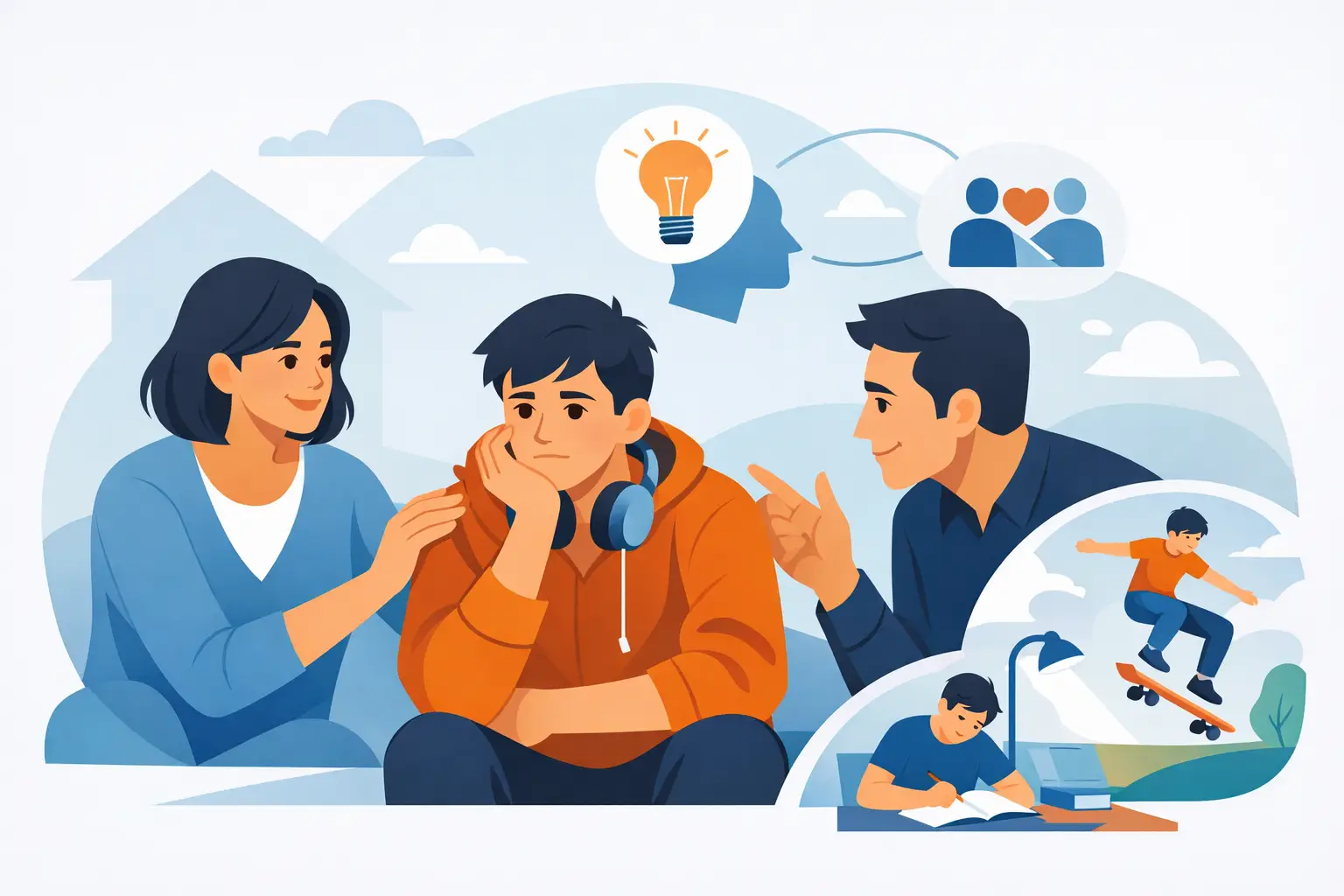
When your teen forgets the assignment again, blows up over a small request, or insists they will do it later and then simply cannot start, it can feel personal. For many families, parent support for ADHD teens is not about trying harder or being stricter. It is about understanding what ADHD is doing in day-to-day life, then putting the right structure around your teenager so home feels calmer and progress becomes more realistic.
Teen ADHD often shows up at the exact stage when parents are expected to step back. That is part of what makes this period so hard. Your teenager wants more independence, but their executive functioning may still be making planning, task initiation, emotional regulation and follow-through much harder than it looks from the outside. What helps is not more pressure. What helps is practical support that respects both their age and their nervous system.
Why parent support for ADHD teens matters so much
ADHD in the teen years is rarely just about attention. It often affects sleep, motivation, organisation, schoolwork, friendships, self-esteem and family relationships all at once. Parents are usually the people trying to hold those moving parts together. That can mean chasing forms, checking homework portals, reminding about sport gear, managing appointments and absorbing the emotional fallout when things go wrong.
Over time, even loving families can get stuck in a pattern of reminders, arguments and shutdowns. Parents feel exhausted. Teens feel criticised. Neither side is trying to create conflict, but the cycle becomes familiar.
This is where the right support changes things. Parent support does not mean taking over everything. It means learning which parts of daily life your teen can manage, which parts still need scaffolding, and how to support growth without tipping into constant tension.
What ADHD can look like in teenagers
Some teens with ADHD are outwardly busy, impulsive and restless. Others look quiet but are overwhelmed inside. Some do well academically while struggling with deadlines, sleep and emotional control behind the scenes. Girls, in particular, may mask heavily and get labelled as anxious, messy or overly sensitive rather than recognised for ADHD-related challenges.
That is why a one-size-fits-all parenting response rarely works. A teen who forgets tasks may not need a lecture on responsibility. They may need an external system because working memory is unreliable. A teen who explodes after school may not be choosing defiance. They may be running on stress, masking fatigue and low regulation.
Understanding this does not remove boundaries. It makes boundaries more effective because they are built around how your teen actually functions.
The kind of parent support for ADHD teens that works best
The most effective support is usually consistent, calm and specific. It is less about big motivational speeches and more about repeatable systems that lower friction.
Start with routines that are visible and simple. Morning routines, homework start times, charging devices overnight, packing school bags before bed and having one place for important items can all reduce pressure. The goal is not perfection. The goal is making the next step obvious.
Language matters too. Many teens with ADHD already feel they are failing at things that seem easy for everyone else. If every conversation starts with what they missed, forgot or left until the last minute, shame builds quickly. Shame does not improve executive functioning. In fact, it often makes avoidance worse.
A better approach is to be direct without being loaded. Instead of saying, “You never listen” or “Why are you like this?” try naming the problem in a neutral way. “The assignment is due tomorrow and you have not started yet. Let’s work out the first step.” This keeps the focus on problem-solving rather than blame.
Support without over-supporting
One of the hardest parts of parenting an ADHD teen is knowing when to step in and when to step back. If you do too much, your teen may rely on you for every cue. If you withdraw too quickly, things can unravel fast.
The answer is usually gradual transfer, not sudden independence. Think of support as scaffolding. You might help set up the planner, but your teen ticks off the tasks. You might sit nearby while they begin homework, but you do not complete it for them. You might check that the uniform is ready at night, but they are the one who puts it in place.
This balance takes trial and error. Some weeks your teen will manage more. During stress, exams, friendship issues or poor sleep, they may need extra support again. That is not backsliding. It is adjusting to capacity.
Reducing conflict at home
Many parents tell themselves they need to be more patient, but patience alone is not a strategy. If the same arguments happen every day, something in the system needs to change.
Timing is one of the biggest factors. Teens with ADHD often struggle with transitions, especially when they are hungry, tired or deeply focused on something else. A demand shouted from another room is more likely to spark conflict than a planned check-in with a clear next step. Instead of repeated verbal reminders, try one agreed prompt, then a visual cue or routine.
It also helps to separate urgent issues from non-urgent ones. If every missed chore, messy floor and forgotten lunchbox becomes a major confrontation, home starts to feel like a constant correction zone. Pick the issues that truly matter and make expectations clear. Let smaller things stay smaller where you can.
Connection also matters more than many families expect. Teens are more likely to accept support from a parent who does not feel like a full-time manager. Even ten quiet minutes in the car, a shared snack after school or a low-pressure conversation before bed can reduce defensiveness and make collaboration easier.
School pressure, motivation and follow-through
School can become the flashpoint for families because it holds so many ADHD pain points at once – deadlines, planning, memory, emotional pressure and self-comparison.
What looks like low motivation is often overwhelm. When a task feels too big, too vague or too late, many teens freeze. Telling them to “just get it done” usually does not solve the paralysis. Breaking work into a first step does. Open the document. Write the heading. Find one source. Spend ten minutes only. Momentum often starts after the task becomes concrete.
Parents can support this without becoming the homework police. Focus on set-up, structure and accountability rather than hovering. A predictable homework time, a body-double approach where someone sits nearby, and clear time blocks with short breaks can all help. So can realistic expectations. Not every teen can manage every subject, sport, social event and extracurricular load without support. Sometimes reducing overload is the smartest intervention.
When outside support makes a real difference
There is a point where family effort alone may not be enough, especially if conflict is constant, school pressure is increasing or your teen’s confidence is dropping. Outside support can help because it brings structure without the emotional charge that often exists at home.
ADHD coaching can be particularly useful for teenagers who need practical systems for time management, emotional regulation, planning, routines and follow-through. It is not about fixing personality traits. It is about building workable strategies for real life. Family-focused coaching can also support parents by giving them clearer tools, more realistic expectations and a shared plan for what happens next.
For some families, support around assessment is also part of the picture, particularly if ADHD is suspected but not yet formally identified. Clarity often reduces self-blame for both parent and teen.
ADHD Coaching Australia works with families in this practical, shame-free way, helping turn daily friction into more manageable routines and clearer support.
What parents need too
Parents of ADHD teens often put all their energy into keeping things afloat and very little into their own support. But if you are constantly depleted, it becomes harder to stay calm, consistent and flexible.
You do not need to be perfect to be effective. You need enough support to keep responding rather than only reacting. That may mean learning more about ADHD, getting guidance around what is developmentally realistic, or having your own space to reset your expectations and approach.
It can also mean letting go of the idea that good parenting should look the same in every family. Your teenager may need more reminders, more structure and more co-regulation than their peers. That is not a failure. It is responsive parenting.
The goal is not to create a flawless teen who never forgets a task or loses their cool. The goal is to help your teenager understand how their brain works, trust that support is available, and build skills that will serve them well beyond school. Sometimes the most powerful shift is moving from “Why can’t they just do it?” to “What would make this easier to start, manage or finish?” That question opens the door to progress, and often to a much calmer home as well.